

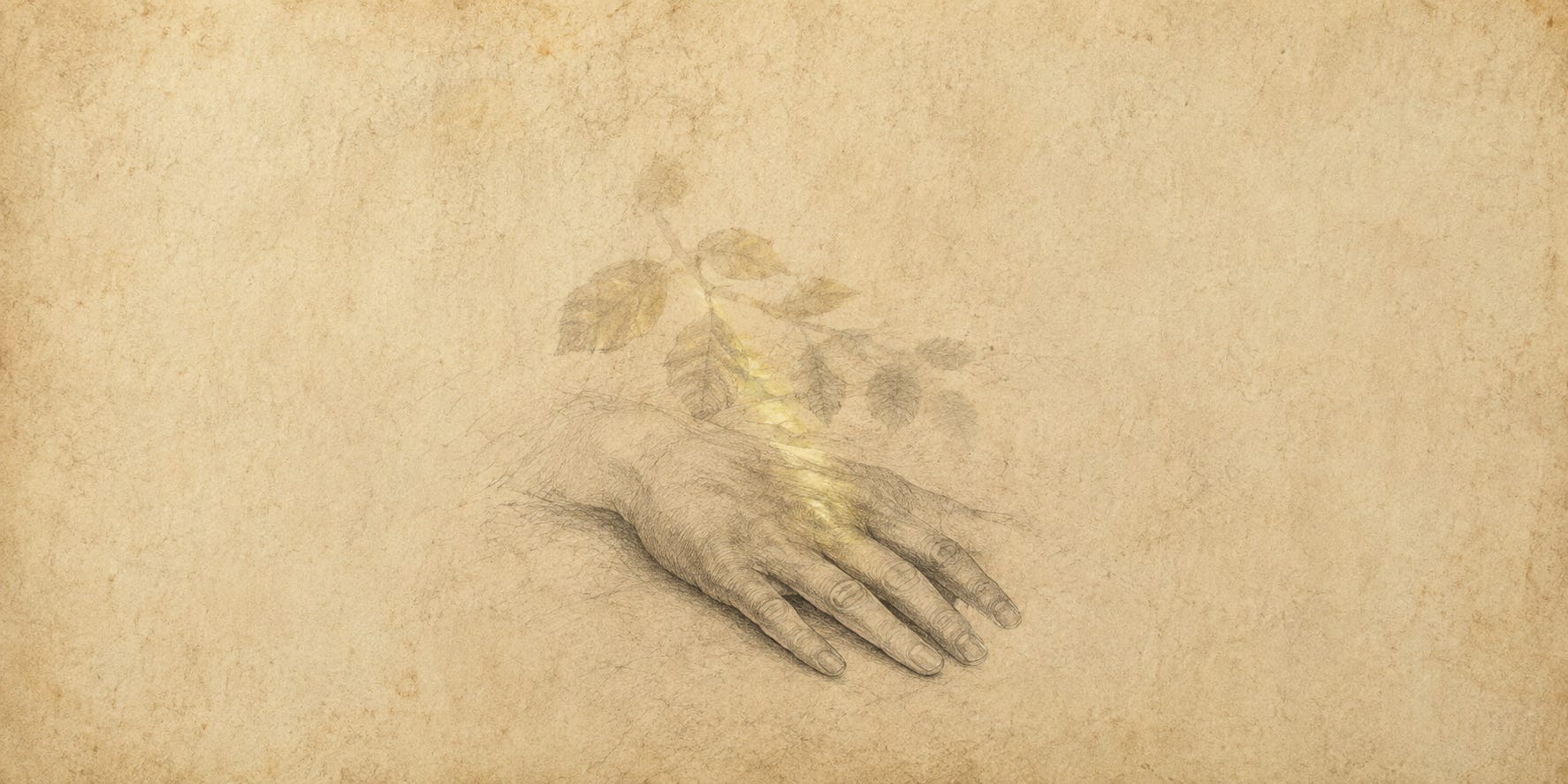
Sam wakes beneath young beech leaves in Ithilien and asks the question on which Tolkien’s whole theory of story turns:
“Is everything sad going to come untrue?”
The answer before him seems to be yes.
Gandalf is alive. Frodo lies beside him. The Ring has been destroyed, the Dark Tower has fallen, and sunlight is moving through the leaves. Only hours earlier, Sam had believed that he and Frodo would die together upon the ruin of Mount Doom. Now the world has been given back to him. He laughs, and his laughter becomes weeping, and then he laughs again.
Yet Frodo’s hand is already altered.
One finger is missing. The wound has crossed with him into the restored world. Before the book closes, other wounds will reveal themselves: the knife, the sting, the long burden that cannot simply be set down when the object that caused it has vanished. Frodo will return to the Shire, but he will not be able to return to the life he left there. He has saved his home and lost the power to live wholly within it.
The scene contains the whole of Tolkien’s eucatastrophe: the joy is real, and so is the wound.
The word appears in “On Fairy-Stories,” where Tolkien finds the ordinary language of happy endings inadequate to describe what the fairy-story can do. The ending he has in mind is not merely fortunate. It is not the moment when the deserving are rewarded, the enemy is defeated, and the pieces of the world are placed neatly back where they belonged. Tolkien calls it the “sudden joyous turn”: a reversal arriving when catastrophe appears complete, not as something the characters can command, but as “sudden and miraculous grace” (“On Fairy-Stories,” “Recovery, Escape, Consolation”).
A happy ending tells us that events have turned out well.
Eucatastrophe alters what we believe the whole story means.
It does not make the darkness imaginary. The danger must have been real, and defeat must have remained possible, or the turn has no power. Tolkien insists that eucatastrophe does not deny sorrow or failure. It denies something more absolute: “universal final defeat.”
The qualification matters more than the comfort.
A particular hope may fail. A beloved thing may be lost. A kingdom may fall, and a wound may remain beyond the reach of any healing available within the world. Tolkien’s stories do not lack such losses. Beleriand sinks. Númenor is drowned. The Elves diminish. Elrond and Arwen are parted. Túrin’s tale closes around a grief no mortal action can reverse.
Eucatastrophe does not declare that these things never happen.
It declares that they do not possess the final meaning of everything that happens.
This is why Tolkien’s joy is unlike optimism. Optimism reads the evidence and predicts improvement. It expects the road ahead to rise because the road behind has begun to rise already. Eucatastrophe comes when prediction has exhausted itself. It enters not from the visible tendency of events but across it.
In Letter 89, Tolkien describes its effect as a joy that brings tears. The reader does not first analyse the turn and then approve it. The whole being responds before thought has caught up, as though something long dislocated in reality has suddenly returned to its place. For a moment, the story seems not merely to have changed direction but to have disclosed a truth larger than its own events (Letters, no. 89).
The turn feels true before the reader has decided what kind of truth it might contain.
Tolkien knew that he had achieved something of this kind in The Hobbit when he reached Bilbo’s cry at the Battle of Five Armies:
“The Eagles! The Eagles are coming!”
He identifies the moment explicitly as producing the eucatastrophic emotion in him (Letters, no. 89).
The Eagles arrive when the battle has passed beyond any reasonable expectation of rescue. Thorin and his companions are surrounded. The allied forces are exhausted. Goblins descend upon the mountain, and victory has narrowed into the question of how long resistance can continue before it is broken. Bilbo’s cry does not announce the fulfilment of a plan. It announces the entrance of something for which no plan could account.
Yet the Eagles do not make the battle unwounded.
Thorin still dies. Fíli and Kíli die defending him. Victory does not reach backwards and make their deaths unreal. The turn changes the meaning of the battle without abolishing its cost.
Nor can such deliverance become a reliable instrument. If the Eagles descended whenever difficulty appeared, their coming would become logistics rather than grace. A rescue that can be summoned or confidently awaited may bring relief, but it cannot tear the fabric of the story. The eucatastrophic turn must remain beyond possession. Its meaning lies partly in the fact that no character holds it as a power.
This is why the destruction of the Ring is the great eucatastrophic turn of The Lord of the Rings, and why it occurs through the failure of its hero.
Frodo does not stand at the Cracks of Doom and discover, at the last moment, a deeper reserve of strength. He does not complete the Quest through a final triumph of will. Having carried the Ring farther than anyone else could have carried it, he reaches the place where it can be destroyed and claims it for himself (LotR, Book VI, Ch. 3).
The narrative does not soften this.
At the decisive instant, Frodo fails to do the thing for which every mile of the Quest has prepared him.
Had he cast the Ring into the Fire by his own unaided strength, the ending would have confirmed the sovereignty of heroic will. The Quest would have been completed because the hero proved morally equal to it. The long accumulation of pity, restraint, endurance, and undeserved preservation would have become secondary to a final act of mastery.
But the Ring cannot be mastered into destruction.
It has already exposed the desire for mastery as its deepest temptation. Its end cannot therefore be achieved by making Frodo sufficiently powerful over himself. At the final threshold, even the righteous will to destroy power is overcome by the power it has carried.
Then Gollum appears.
He attacks Frodo, takes the Ring, rejoices in possessing it, loses his footing, and falls. The Ring is destroyed through the creature most completely enslaved to it.
The event is sudden, but it is not arbitrary. Its possibility has been preserved across the whole story.
Long before anyone knows what part Gollum may yet play, Bilbo spares him beneath the Misty Mountains. Gandalf later tells Frodo that even the wise cannot see all ends, and that pity may govern the fate of many (LotR, Book I, Ch. 2). Frodo, despite fear and revulsion, refuses to treat Gollum’s death as a simple necessity. Sam, on the final approach to Mount Doom, also finds himself unable to kill him. Each act leaves alive a future none of the merciful characters can understand.
They do not spare Gollum because they foresee that he will destroy the Ring.
Had they known, their mercy would have become calculation.
Pity is not a concealed strategy. It does not purchase a favourable ending or oblige providence to reward the person who practises it. It refuses to close the future around the certainty of present judgement.
Mercy makes room for an end it cannot imagine.
Tolkien writes of Frodo as having received grace sufficient to carry the burden as far as he did, not strength sufficient to overcome it without limit. At the point where his own capacity ends, the consequences of earlier pity remain. Providence does not replace moral action. It gathers actions whose meaning exceeded the knowledge of those who performed them (Letters, no. 246).
Frodo reaches the Fire because he has endured. Gollum reaches it because others have spared him. The Ring is taken because Frodo fails. It is destroyed because Gollum succeeds in the one desire that has ruined him. Every will remains recognisably itself, yet the total pattern belongs to none of them.
Evil participates in its own overthrow without ceasing to be evil.
Gollum’s possessiveness is not redeemed into virtue at the edge of the Fire. The Ring’s corruption remains corruption. Frodo’s failure remains failure. Yet none of these can command the meaning of the whole.
The design is larger than the intentions moving within it.
This is also Ilúvatar’s answer to Melkor before the beginning of the world. Discord enters the Music and wounds what follows from it, but it cannot become an independent act of creation. It can make suffering real. It can mar beauty, twist freedom, and leave consequences that cannot be made as though they had never been. It cannot establish a final theme outside the source from which all themes receive their being (Silm, “Ainulindalë”).
At Mount Doom, that metaphysical claim becomes narrative.
The Ring is not overcome by a stronger Ring. Domination is not defeated by a more righteous domination. The instrument through which Sauron intends to make every will subordinate to his own is lost through the convergence of wills he could neither understand nor govern.
Power is defeated by what power cannot calculate: pity long past, endurance without certainty, and mercy shown to a creature who seemed to deserve none.
Then Sam sees Frodo’s hand.
The plot has overcome the Ring. The body records the cost.
Frodo and Sam are rescued from the mountain, honoured before the host of the West, and celebrated in song. Their ordeal enters the memory of a restored world. But restoration does not reach equally into every life that made it possible.
Frodo returns to the Shire and discovers that victory has not returned him to himself. He tells Gandalf that there is no true going back because the person who returns is not the person who departed. The knife, the sting, the long burden, and the loss of the Ring recur within him. Gandalf does not promise that time will repair everything. He answers that “some wounds cannot be wholly cured” (LotR, Book VI, Ch. 7).
The Shire may be restored. Frodo cannot be restored simply by living in it.
Merry and Pippin return enlarged in the sight of their neighbours. Sam plants, marries, raises children, and participates in the renewed life of the land. Frodo withdraws quietly from it. The world grows whole around the person in whom its brokenness remains.
Tolkien says that Frodo has sacrificed himself so completely for the preservation of the Shire that he has little heart left to enjoy it. His suffering includes a dark self-reproach. Because he did not surrender the Ring voluntarily, he can mistake the Quest for a personal failure, even though no one could have carried the burden farther (Letters, nos. 131 and 246).
The great turn has occurred, but Frodo cannot wholly receive its consolation.
This seems to stand against Sam’s question beneath the beech leaves. If everything sad is becoming untrue, why does Frodo remain wounded? Why must he leave the country whose continued existence he purchased with his own peace? Why does the book end not at Cormallen, where grief and joy flow together, but at the Grey Havens, where the Fellowship is finally divided?
The contradiction reveals the true scale of Tolkien’s thought.
Eucatastrophe is not the final restoration. It is the finite story’s sudden apprehension that final restoration exceeds the limits of what the story can presently contain.
At Cormallen, Sam receives a glimpse of an answer. Gandalf is alive. Frodo is beside him. The Shadow has passed. The world has not ended in ash.
The answer is true, but it is not complete.
Not everything sad has yet come untrue.
Frodo’s hand remains altered. The Elves will still depart. The Fellowship cannot remain together. Arwen will accept a grief for which there is no comfort within the circles of the world. Victory over Sauron does not halt time, undo mortality, restore every drowned land, or heal Arda of every wound.
Eucatastrophe does not claim that it does.
It denies that these losses possess universal final authority.
Tolkien describes its joy as a glimpse because the story cannot hold the whole of what it reveals. For a moment, its fabric seems to open. The reader does not possess the greater reality beyond the opening, and the characters do not enter it fully. They see only enough to know that the walls of the present story are not the walls of all existence.
Tolkien calls this evangelium: good news entering at the point where the visible world has exhausted every reason for expecting it.
The word leads directly to the Epilogue of “On Fairy-Stories,” where Tolkien turns from the consolation of invented tales to the Christian story. His literary theory reaches theology because the piercing joy of the fairy-story seems to him to carry an echo of something more than fiction can supply.
The fairy-story gives a fleeting apprehension that sorrow may not have the final word. The Gospel, as Tolkien understands it, declares that this apprehension entered history.
Tolkien calls the Birth of Christ the eucatastrophe of human history and the Resurrection the eucatastrophe of the Incarnation. The movement is not merely from misfortune to fortune, or from death to survival. It is the entrance of an answer that could not be produced by the chain of events it transforms (“On Fairy-Stories,” Epilogue).
For Tolkien, the Resurrection is not simply another example of the pattern.
It is the event that makes the pattern more than wish fulfilment.
The stories human beings make can offer echoes of the sudden turn. They can allow the fabric of an invented world to open and let a gleam pass through. But the Gospel, in Tolkien’s belief, is where the echo and its source meet: where the story that most deeply fulfils human desire is also the story that entered the Primary World.
This conviction does not make The Lord of the Rings an allegory of Christianity. Tolkien keeps explicit religion outside the immediate forms of Middle-earth. Religious truth is absorbed into the story’s structure rather than displayed through a system of coded correspondences in which one character secretly stands for Christ and another for Satan.
The theology is present as a narrative law.
The dead do not always return. The wounded are not always healed within the lands that wounded them. Courage may end in defeat, beauty may fade, and the work of preservation may cost its preserver the power to enjoy what remains. Tolkien does not weaken these things in order to defend hope.
He permits hope to begin only after sorrow has been granted its full reality.
Eucatastrophe does not tell the grieving person that the loss was simple, necessary, or secretly desirable. It does not turn pain into evidence of favour. It offers no explanation capable of making sorrow cease to be sorrow.
It discloses instead that sorrow is not self-interpreting.
The wound tells the truth about what has been suffered. It does not tell the whole truth about the world in which the suffering occurred.
Morgoth can wound matter, but matter does not therefore become Morgoth’s. Sauron can shape events towards domination, but he cannot master the pity he despises. Frodo can fail at the last, but his failure does not become the meaning of everything he has endured. Gollum can remain enslaved to the Ring, yet his slavery can serve an end his master never intended. History can appear as a long defeat without defeat becoming the final form of history.
The joy sorrow cannot foresee is not the joy of discovering that no loss was real.
It is the joy of discovering that loss was never sovereign.
Sam wakes under young leaves. Gandalf laughs. Frodo lies beside him, saved and wounded. The Shadow has passed, but its mark remains upon the hand resting in the light.
Sam laughs until he weeps.
He has seen Mordor. He will live to see Frodo leave. He does not yet know how much of what has been saved will still have to be surrendered. His joy is not innocence restored. It comes after knowledge, and it carries grief within it.
For one moment, the story opens beyond its own walls.
The wound remains.
It is no longer the whole world.
From the Workroom
This essay nearly consoled more completely than Tolkien’s story permits.
In the companion Author’s Note, I write about why Frodo’s altered hand had to become the governing image—and why the essay’s cleanest structure had to be surrendered before its hope could become trustworthy.
Enter the Workroom: The Answer That Could Not Be Complete →
The Mytharium is a reader-supported publication. Subscribe free to receive future essays on Tolkien, myth, legend, and literature.