

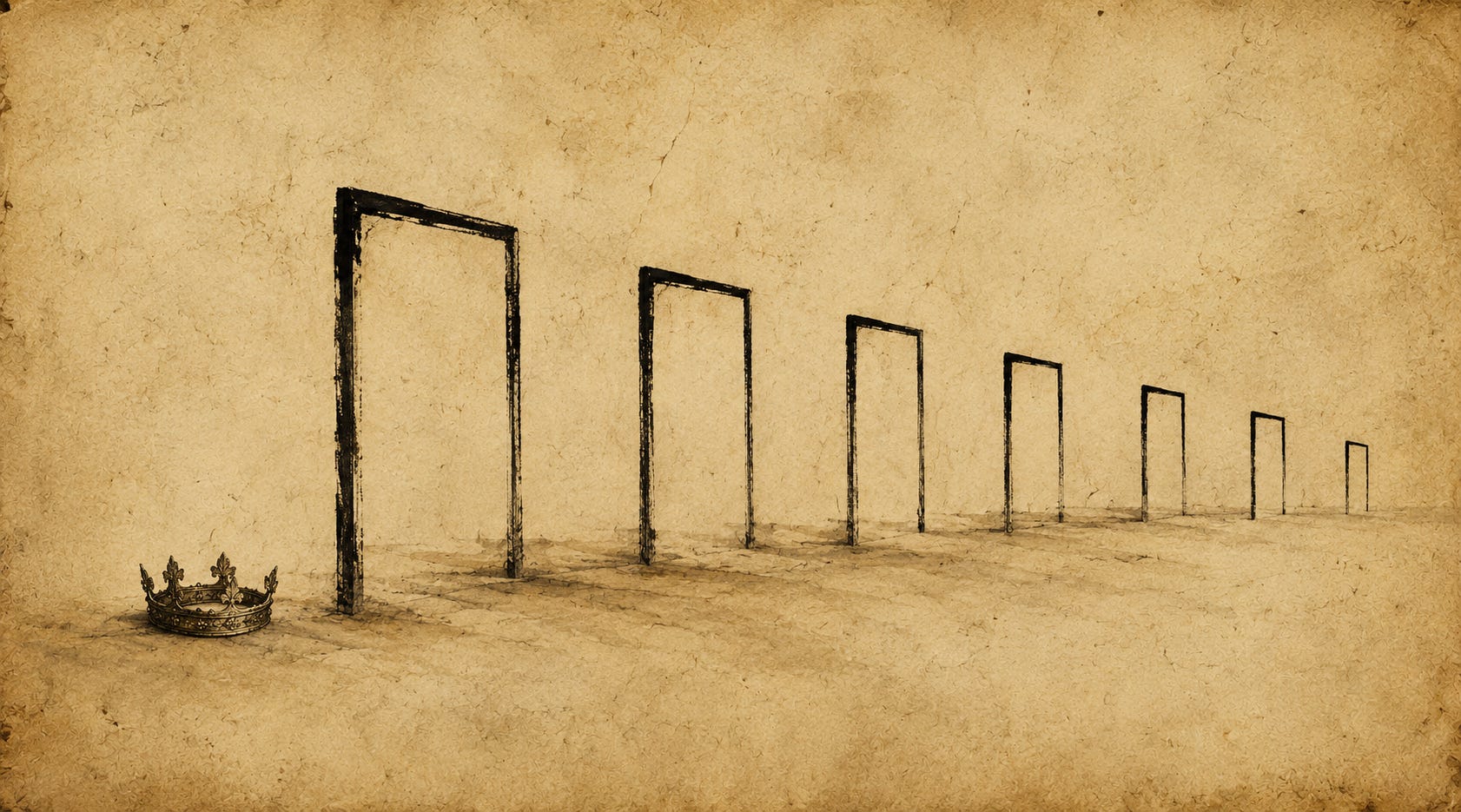
Inanna set her heart on the great below.
She did not go as one taken by force. She fastened the crown upon her head. She gathered the beads at her throat, the breastplate against her body, the ring, the rod, the line, the robe. She put on the signs by which heaven and earth knew her.
Then she called Ninshubur, her faithful attendant, and gave the command.
“If I do not return,” Inanna said, “go to the temples of the great gods. Lift your voice. Beat the drum of mourning. Do not let silence close over me.”
Ninshubur listened. She received the words and held them.
Then Inanna turned from the bright places.
She left the upper world, where her name was spoken with desire and fear, and came to the road that leads down. The air changed around her. Light thinned. Sound withdrew into itself. Ahead stood the gate of the great below, shut and dark in the earth.
Inanna struck the gate.
The gatekeeper came.
“Who comes to the house from which none return?”
“Inanna,” she said. “Queen of heaven. Lady of the powers above.”
The gatekeeper looked at the crown, the beads, the breastplate, the robe, the signs of splendour gathered upon her.
He did not open.
He went down to Ereshkigal, queen of the great below, and spoke the name of the one who waited at the gate.
Ereshkigal heard it.
Her face did not soften.
“Open the gates,” she said. “But open them according to the rites of this place.”
So the gatekeeper returned.
The first gate opened.
Inanna stepped forward.
At the first gate, they took the crown from her head.
“Why is this done?” Inanna said.
“Be quiet, Inanna,” said the gatekeeper. “The rites of the underworld are perfect. They must not be questioned.”
So she passed through without the crown.
The second gate opened.
At the second gate, they took the beads from her throat.
“Why is this done?” Inanna said.
“The rites of the underworld are perfect.”
So she passed through without the beads.
The third gate opened.
At the third gate, they took the breastplate from her body, the bright thing that had covered her with splendour and force.
“Why is this done?”
“They must not be questioned.”
So she passed through without the breastplate.
The fourth gate opened.
At the fourth gate, they took the ring from her hand.
She passed through without the ring.
The fifth gate opened.
At the fifth gate, they took the rod and the line, the measures of rule, the instruments by which order is marked and possession known.
She passed through without the rod and the line.
The sixth gate opened.
At the sixth gate, they took the ornaments from her body, all that still held the memory of light.
She passed through without the ornaments.
The seventh gate opened.
At the seventh gate, they took the robe.
There was no splendour left upon her. No crown named her. No jewels announced her. No garment stood between her and the law of the place she had entered.
She stood naked in the great below.
This time she did not ask.
They brought her before Ereshkigal.
The queen of the underworld sat upon her throne. Around her were the powers of the place below, old and watchful, colder than anger. Ereshkigal looked upon Inanna, and the look was judgement.
Inanna had come as queen.
She stood as one from whom queenhood had been taken.
No crown answered for her. No robe. No bright ornament. No measure of rule. Only the one who had chosen to descend.
Then the judgement of the underworld fell upon her.
Inanna was made still.
Above, the world waited.
Ninshubur counted the days.
When Inanna did not return, Ninshubur tore at the silence. She beat the drum of mourning. She went to the temples of the great gods and lifted her voice. Some would not answer. Some would not intervene. The great below was not a house to be entered lightly, and its law was not easily turned aside.
But Enki heard.
Enki, lord of deep wisdom and fresh water beneath the earth, knew that greatness could not command what the gates had already refused.
So he made two small beings, slight enough to pass where splendour could not pass. He gave them the food of life and the water of life. He sent them down by the road Inanna had taken.
They came to the great below.
There they found Ereshkigal.
The queen of the dead was in pain. Her cries filled the chamber. The suffering of the underworld had a voice, and the voice did not ask to be understood. It sounded because it had no other law.
The two beings did not command her.
They did not rebuke her.
When Ereshkigal cried out, they cried with her.
When she groaned, they answered the groan.
When she named her pain, they gave it back to her, not as mockery, but as witness.
The queen of the underworld heard herself received.
Then she looked upon them with favour.
“Ask,” she said, “and I will give.”
They did not ask for silver. They did not ask for grain. They did not ask for the treasures of the lower house.
They asked for the body of Inanna.
Ereshkigal gave it.
The two beings took the food of life and the water of life and touched Inanna with them.
Inanna rose.
The crown did not rise first. The robe did not rise first. The ornaments did not rise first. The name did not rise first.
Inanna rose.
But the underworld does not release without remainder.
As she turned upward, the dead came with her. They followed at her side like a shadow that had learned to walk. Their eyes were fixed upon the living world. Their hands were empty. Their claim was not.
A voice went with them:
“No one ascends from the great below unless another descends in her place.”
So Inanna returned by the road that had unmade her.
She passed the gates again. The dark thresholds opened behind her and closed. The upper air drew near. Light returned by degrees, not as triumph, but as something remembered.
Above, Ninshubur came to meet her.
Ninshubur had mourned. Ninshubur had kept the command. She had not let silence close over her mistress.
The dead looked upon Ninshubur.
Inanna would not give her.
They came to others who had grieved, and Inanna would not give them.
Then she came to Dumuzi.
He was seated in splendour.
He had not put dust upon himself. He had not lowered his head. He had not stood in the doorway watching for her return. He sat upon his throne, clothed in brightness, while she came back from the place where every brightness had been taken.
Inanna looked at him.
The dead waited.
The old law stood between them.
Then Inanna gave the sign.
The dead seized Dumuzi.
He cried out. He struggled against the hands that had come from below. But the underworld had followed Inanna back into the upper world, and its claim had found a name.
So the story opened into another grief.
The lover would descend. The sister would mourn. The year would learn the rhythm of absence and return. The house of the living would know that the great below had not been cheated. It had only changed the face of its debt.
As for Inanna, the signs of the upper world could be restored.
The crown could be lifted again. The robe could be placed again upon her body. The beads could return to her throat. Desire could move again in the fields and houses of the living. Her name could be spoken again with fear and longing.
But the gates had opened for her.
They had brought her naked before the queen below. They had made her still. They had released her only under the law of another name.
The crown had returned to the upper world.
But below, the gates had not forgotten.
They had opened once for Inanna.
Now they waited for the name that would answer hers.
Source Note: This retelling follows the Sumerian descent tradition usually known as The Descent of Inanna or Inanna’s Descent to the Underworld, with the seven-gate sequence, Ereshkigal’s underworld sovereignty, Ninshubur’s appeal, and Inanna’s return under the law of substitution. It is a literary rendering rather than a translation.